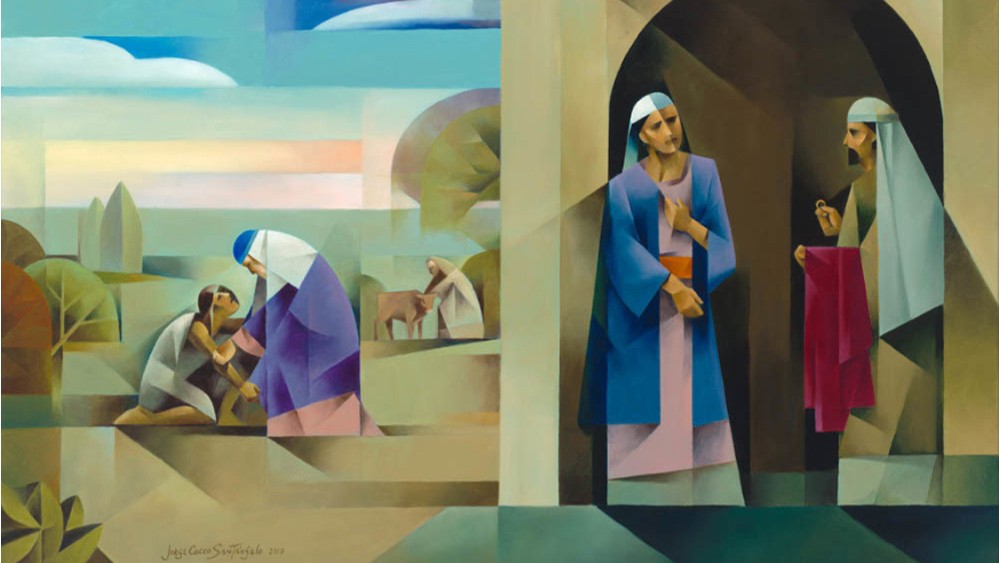


“For the kingdom of heaven is like a landowner who went out early in the morning to hire workers for his vineyard. He agreed to pay them a denarius for the day and sent them into his vineyard.
“About nine in the morning he went out and saw others standing in the marketplace doing nothing. He told them, ‘You also go and work in my vineyard, and I will pay you whatever is right.’ So they went.
“He went out again about noon and about three in the afternoon and did the same thing. About five in the afternoon he went out and found still others standing around. He asked them, ‘Why have you been standing here all day long doing nothing?’
“‘Because no one has hired us,’ they answered.
“He said to them, ‘You also go and work in my vineyard.’
“When evening came, the owner of the vineyard said to his foreman, ‘Call the workers and pay them their wages, beginning with the last ones hired and going on to the first.’
“The workers who were hired about five in the afternoon came and each received a denarius. So when those came who were hired first, they expected to receive more. But each one of them also received a denarius. When they received it, they began to grumble against the landowner. ‘These who were hired last worked only one hour,’ they said, ‘and you have made them equal to us who have borne the burden of the work and the heat of the day.’
“But he answered one of them, ‘I am not being unfair to you, friend. Didn’t you agree to work for a denarius? Take your pay and go. I want to give the one who was hired last the same as I gave you. Don’t I have the right to do what I want with my own money? Or are you envious because I am generous?’
“So the last will be first, and the first will be last.”
Reflection
We love the law of fairness. We want the world to run on a predictable contract: if you work longer, invest earlier, or suffer more, you deserve a bigger payout. When the earliest workers in Jesus' parable saw those hired at the eleventh hour get paid a full day's wage, they expected a bonus. When they got the same, they felt cheated. They operated on contract law, measuring their worth by what they thought they were owed.
Jesus flips this worldview completely on its head. God isn't an employer keeping a strict timesheet, and life with Him isn't a business deal where we negotiate our wages. When we view God through the lens of strict fairness, we end up like the older brother in the prodigal son story—feeling like resentful slaves rather than beloved children. The landowner paid everyone a full denarius because he was generous, not because they earned it. The greatest reward in God’s Kingdom isn't a calculated payout for our labor; it is the privilege of being welcomed into His vineyard and sharing in the generosity of the Father.
Reflection Question
Where in your spiritual life have you slipped into a "contract mindset"—expecting God to pay you back for your effort rather than resting in His unearned grace?
Prayer
Father, forgive me for measuring Your goodness through the lens of human fairness. Help me stop keeping score of what I think I am owed, and let me simply marvel at Your scandalous generosity today. Amen.